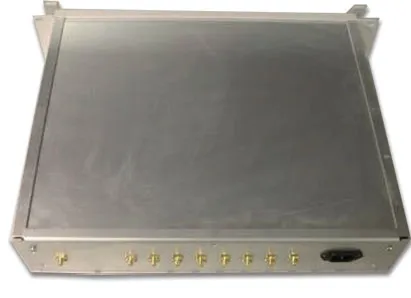
Resistive and Wilkinson Power Dividers
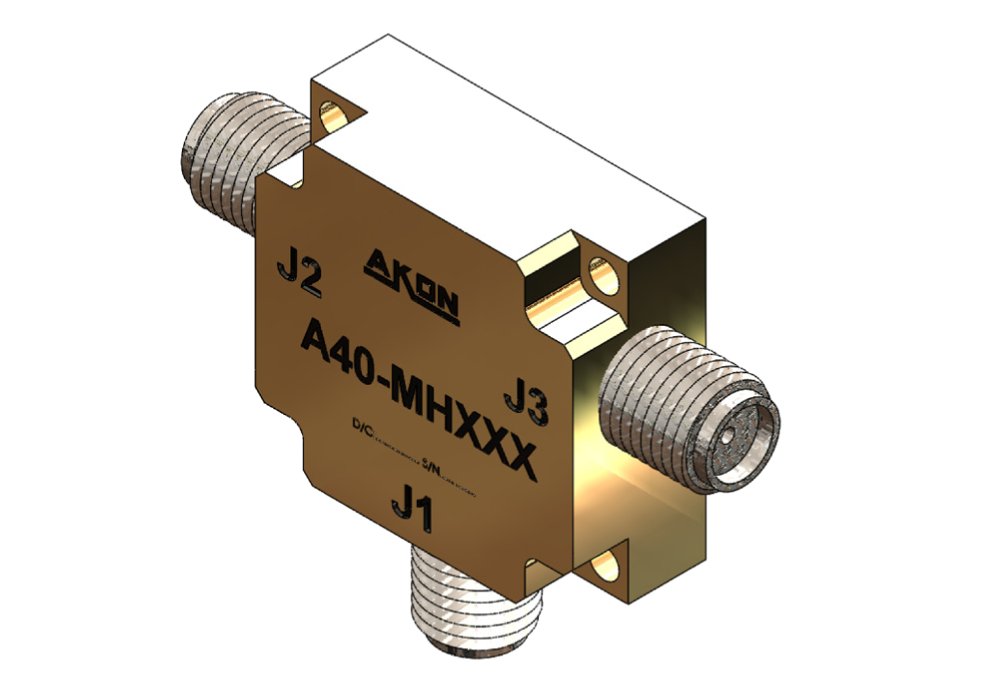
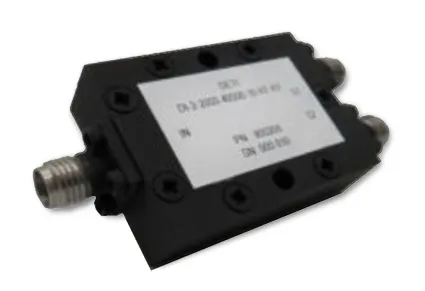
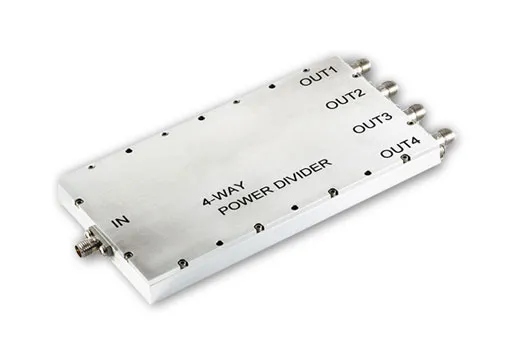
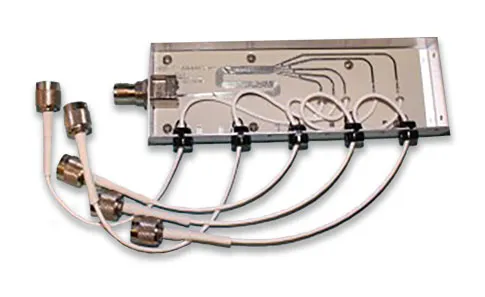
A power divider splits one input into several outputs — or combines several inputs into one — and the topology chosen determines how much loss the system takes and how well the output ports are isolated from one another. Princeton Microwave supplies both resistive and Wilkinson designs in 2-way through 8-way configurations.
Resistive Dividers
A resistive divider uses a simple resistor network. It is inherently broadband, working from DC upward with no frequency-dependent elements, and it holds a good match at every port. The tradeoff is loss: a resistive 2-way divider dissipates power in the resistors, and the output ports are not isolated from one another. Resistive designs suit instrumentation, signal monitoring, and test setups where bandwidth matters more than efficiency.
Wilkinson Dividers
A Wilkinson divider uses quarter-wave transmission line sections with an isolation resistor between output arms. Within its design band it approaches the theoretical minimum split loss while providing real isolation between outputs — so a mismatch or fault on one port does not propagate to the others. This makes Wilkinson designs the standard choice for antenna feed networks, phased array distribution, and power combining on the transmit side.
Selecting a Configuration
- Bandwidth — resistive for very wide or DC-inclusive coverage, Wilkinson for defined bands with low loss
- Isolation — required whenever a fault or mismatch on one output must not disturb the others
- Insertion loss — matters most in receive chains and wherever transmit power budget is tight
- Amplitude and phase balance — critical in phased arrays and monopulse feeds, where port-to-port tracking sets beam accuracy
- Power handling — combining applications must tolerate full input power plus any reflected power
Custom port counts, frequency coverage, connector styles, and screening are available for military and space applications.
Configurations: 2-Way | 4-Way | 5-Way | 8-Way | Resistive Power Dividers
Related products: Couplers | T/R Modules | Satellite Components